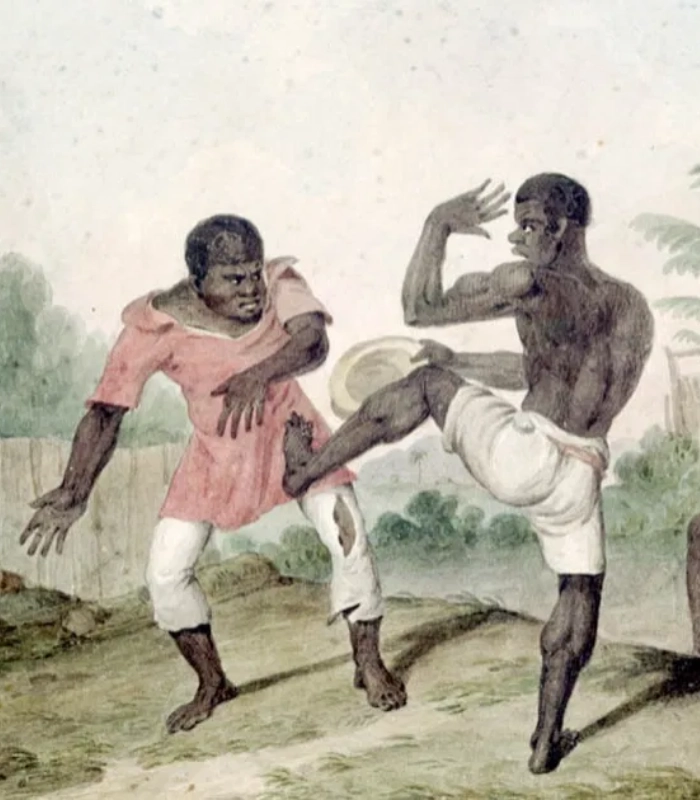
Capoeira Class in Rio de Janeiro
Join us every Thursday afternoon for capoeira classes in Rio de Janeiro! Capoeira is a Brazilian martial art that blends elements of dance, acrobatics, and music. Known for its quick and complex movements, capoeira utilizes power, speed, and leverage for a variety of kicks, spins, and agile techniques that alternate with slower dance moves.
Our classes are held in Lagoa, a beautiful area in Rio de Janeiro, where you can practice capoeira on the shore of the lake, which offers several spots with stunning views. Lagoa is also a popular destination for locals, known as Cariocas, who enjoy walking, jogging, cycling (there is a cycle path that circles the lake), or having a picnic.
All skill levels are welcome in our capoeira classes—there’s no need for you to be an acrobat (but if you are, you’re more than welcome!).
Details
History of Capoeira
Capoeira is not only a fun sport for people of all ages, but it also carries a rich history of Brazil. This unique martial art form was primarily developed by West African descendants in Brazil around the early 16th century, influenced by native Brazilian culture as well.
Capoeira is believed to have been disguised as a dance by enslaved people to deceive their masters. One key aspect supporting this idea is the rapid transitions between martial arts techniques and slow dance movements. According to the story, when a slave master appeared at a ‘roda de capoeira’ (capoeira circle), the capoeiristas would quickly switch from martial arts to more subdued, dance-like motions.
Capoeira was effectively employed during the Paraguayan War (1865-1870), a conflict that led to the emancipation of many enslaved individuals. However, in 1890, a long period of prohibition against capoeira was enacted throughout Brazil. During this time, anyone caught practicing capoeira faced arrest and abuse by the police. It was not until the 1920s that capoeira was once again made legal.
Capoeira schools can be found throughout Brazil, and in recent years, the practice has gained popularity worldwide, spreading to Europe, Asia, Australia, the USA, and Canada. In addition to learning a martial art and a variety of exciting acrobatic moves, they can also learn about Brazilian history and develop important qualities such as respect and discipline.