

 Deutsch
 Français
 Português
 Español
Blog
12 Portuguese words hard to pronounce
1 Comment

Even though Portuguese is not a hard language to learn, there are a few Portuguese words foreigners might find very hard to pronounce. However, the level of difficulty depends on the native language you speak, so you might find them easy or too hard. Here we are going to see 12 examples of them, which most of our students think are hard to say. Let’s take a look at them.
Click here for other Portuguese words hard to pronounce.
Avô vs. Avó (grandfather vs. grandmother)
 This couple of Portuguese words are a nightmare for many foreigners. They just cannot hear the difference between them. It is actually quite simple: avô, the male version, has a closed sound. It is pronounced just as /to/ in todos or as the first /o/ in obrigado (thank you). Avó, on the other hand, has an opened sound, pronounced as /ó/ in ótimo (great) or /o/ in lógica (logic) or in /o/ in olives.
Example: Meu avô é brasileiro, mas minha avó é francesa. (My grandfather is Brazilian but my grandmother is french.)
Amanhã vs. Manhã (tomorrow vs. morning)
These Portuguese words are simple, just a matter of remembering to add the a at the beginning when you want to say tomorrow. Also do not forget to make the nasal sound (the air comes through your nose instead of the mouth) when saying either of them.
Example: Amanhã vou à praia de manhã cedo. (Tomorrow I will go to the beach early in the morning.)
Coco vs. Cocô (coconut vs. poop)
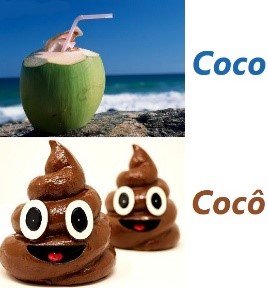 Mispronounce these words can put you in a funny situation. Make sure you stress the first /co/ when you want to say coconut and you stress the second one when you want to say poop.
Examples:
Por favor, eu quero uma água de coco bem gelada. (Please, I want a really cold coconut water.)
Você deve limpar o cocô do seu cachorro. (You should clean up your dog’s poop.)
Perigoso vs. Preguiçoso (dangerous vs. lazy)
It is quite common for the students to mix these words up. They frequently switch them since they think they have a similar pronunciation.
Examples:
Alguns lugares da cidade são perigosos para visitar à noite. (Some of the places in the city are dangerous to visit at night.)
Marcos não quer ir à academia comigo. Ele é muito preguiçoso. (Marcos does not want to go to the gym with me. He is too lazy)
Pão vs. Pau (bread vs. stick/penis)
 Pão is one of the words you will say many times in Portuguese. For that reason, it is very important to learn how to say it correctly. Thus, make sure you use the nasal sound (the air comes through your nose instead of the mouth) to say pão. Otherwise, people will laugh thinking you are saying pau instead.
Examples:
Por favor, eu quero um pão de queijo para viagem. (I want one cheese bread to go, please.)
Ele ameaçou bater no cachorro com um pau. (He threatened to hit the dog with a stick.)
Pais vs. País (parents vs. country)
Pais is the plural for pai, meaning father and mother (or just fathers). The stress is on the pa. País, on the other hand, is singular; the plural would be países (countries). The stress is on the ís.
Examples:
Meu irmão mais velho ainda mora com meus pais. (My oldest brother still lives with my parents.)
Em meu país não há muitos brasileiros. (In my country, there are not many Brazilians.)
Now that you have learned the Portuguese words hard to pronounce, make sure you use them correctly.
If you want to learn more about Portuguese words like those and other Brazilian Portuguese tips, please check the other articles in this blog.
Study Portuguese in Brazil and experience the best of Rio de Janeiro. Our special courses include Portuguese + Surf lessons, Portuguese + Capoeira and Portuguese + Samba classes. Learn Brazilian Portuguese while having fun in Rio!