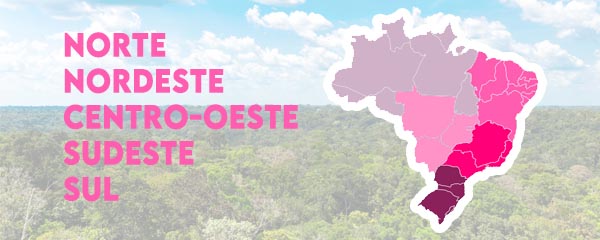

The Brazilian Institute of Geography and Statistics (IBGE) geopolitically divides Brazil into five regions. This division considers geographic aspects of the country, social and cultural elements, and economic factors. The five regions of Brazil are North, Northeast, Central-West, Southeast, and South.
North Region
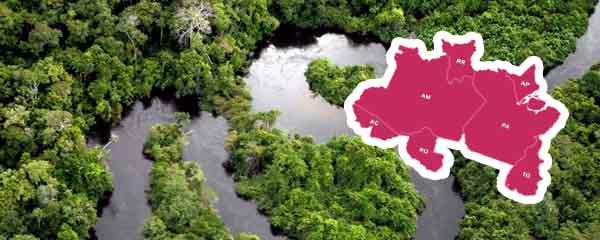
The North region of Brazil is the largest in area, occupying a bit more than 45% of the national territory. It also has the largest biodiversity in the country, thanks to the Amazon Forest. Furthermore, highlands and plains compose most of the geography of the North, as well as natural depressions.
This region was only colonized in the 17th century — mainly by the military and religious priests. True occupation of the North, however, only started during the 19th and 20th centuries. Rubber production was the main reason people moved there in search of a better life.
Even though there are over 18 million people living in the North of Brazil, the population is unevenly distributed. That happens mostly because of the vegetation and the forest. However, it also has to do with the fact that most of the inhabitants choose to live by the rivers’ banks. The lack of infrastructure compared to other regions of Brazil make people from the North rely heavily on water transportation.
Read more: The Main Rivers of Brazil – Explore the Brazilian Freshwaters
After the ’70s, mining and agriculture started to expand in the North. That made this region the second-largest in population growth rate in Brazil. Moreover, the North is also a big industrial hub, home to large multinational companies.
Culture-wise, the North region is home to important festivities of Brazil, such as Círio de Nazaré and the Parintins festival.
States in the North region
| States | City Capitals |
|---|---|
| Acre | Rio Branco |
| Amapá | Macapá |
| Amazonas | Manaus |
| Pará | Belém |
| Rondônia | Porto Velho |
| Roraima | Boa Vista |
| Tocantins | Palmas |
North Data
| Area | 3,853,575 km² |
| Population | 18,430,980 |
| Largest city | Manaus |
| Climate | Equatorial |
| Biome | Amazon Rainforest |
| Main economy | Mining, agriculture, energy production, electronic manufacturing, extractivism |
| Traditional food | Tacacá, Maniçoba, Pato no Tucupi, Cartola |
Northeast Region
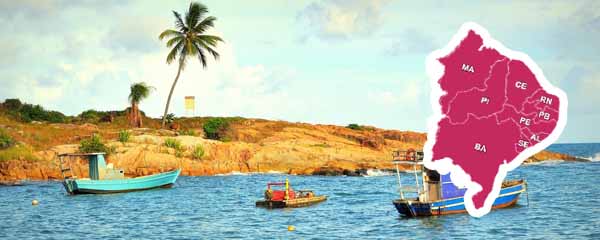
The first Portuguese that came to Brazil in 1500 first arrived in Bahia, in the Northeast of Brazil. Because of that, this is the oldest region to be colonized in the country.
The northeastern vegetation ranges from mangroves, caatinga and cerrado, to sandbanks and Atlantic Forest. It is home to several endemic and endangered species.
Furthermore, tourism is a big source of economy in the Northeast. The coastal cities are home to paradisical beaches, attracting the attention of tourists from all over the world.
However, because this region is located in a semi-arid climate, it is common for cities to have no rain for six or more months straight, making rivers run completely dry during this period. Moreover, unfortunately, the Northeast region of Brazil suffers many socio-economic problems. Among those are lack of agriculture and industry diversity, constant droughts, lack of piped water, sewage treatment, and electricity.
Good rural areas are scarce and near the coast. So, the majority of cities in the Northeast region are located near the sea, making the population poorly distributed. Still, the region houses 28% of the total population of the country.
Moreover, the Northeast region is rich in culture and cuisine. It is popular for its traditional food, festivities, religion, beaches, and arts and crafts.
Watch teacher Josie’s videos on the Northeast of Brazil.
States in the Northeast region
| States | City Capitals |
|---|---|
| Alagoas | Maceió |
| Bahia | Salvador |
| Ceará | Fortaleza |
| Maranhão | São Luís |
| Paraíba | João Pessoa |
| Pernambuco | Recife |
| Piauí | Teresina |
| Rio Grande do Norte | Natal |
| Sergipe | Aracaju |
Northeast Data
| Area | 1,554,291 km² |
| Population | 57,071,564 |
| Largest city | Salvador |
| Climate | Tropical; semi-arid; semi-equatorial |
| Biome | Caatinga |
| Main economy | Agriculture, livestock, industrialized goods, tourism |
| Traditional food | Acarajé, Baião de Dois, Vatapá, Caruru, Bolo de Rolo |
Central-West Region
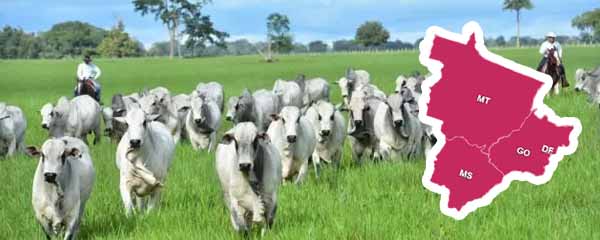
The Central-West region is the least populated in Brazil, even though it has a great area. Its economy relies heavily on agriculture and livestock production. Among the largest productions are soybeans, cotton, sugar cane, and corn.
The region is also home to Brasília, the capital of Brazil. It is a planned city established in 1960 and the third-largest city in Brazil.
The Central-West is a landlocked region, but home to important rivers and basins. It is also home to Pantanal, the world’s largest tropical wetland area and largest flooded grasslands.
A heavy cultural aspect of the Central-West region is the Sertanejo music. It is a Brazilian country music style and the most played music genre on radios in Brazil.
States in the Central-West region
| States | City Capitals |
|---|---|
| Goiás | Goiânia |
| Mato Grosso | Cuiabá |
| Mato Grosso do Sul | Campo Grande |
| Distrito Federal (Federal District) | Brasília |
Central-West Data
| Area | 1,612,000 km² |
| Population | 16,504,303 |
| Largest city | Brasília |
| Climate | Tropical; equatorial |
| Biome | Cerrado (a savanna-like biome); Tropical wetland |
| Main economy | Livestock, agriculture, extractivism |
| Traditional food | Arroz com Pequi, Caldo de Piranha, Mojica de Pintado, Pamonha |
Southeast Region
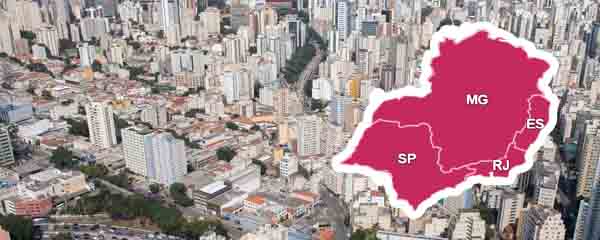
The Southeast region is home to one of the largest megalopolises and the fourth largest city in the world. It is the richest of all regions of Brazil, responsible for approximately 60% of the GDP of the country. São Paulo is also the largest industrial park in South America. Its main industrial activities revolve around iron, steel, metallurgy, petroleum, and high technology.
Moreover, the Southeast region is also a large producer of coffee, sugar cane, orange, and lime.
Historically, the first colony of Portugal was established here in the Southeast, bringing Portuguese men to populate Brazil around 1952. By the 19th century, the royal family came to Rio de Janeiro and founded the new capital of Portugal overseas. Hence, the urbanization process had to expand rapidly and the region grew quickly.
Read more: 15 Interesting Facts About Rio de Janeiro
Tourism is also very important for the area. Rio de Janeiro and São Paulo are one of the most visited cities in South America.
The Southeast is the most populous region in the country, where approximately 42% of the Brazilian population lives. Its vegetation is composed mainly of Atlantic Forest, one of the top five biodiversity hotspots on Earth.
States in the Southeast region
| States | City Capitals |
|---|---|
| Espírito Santo | Vitória |
| Minas Gerais | Belo Horizonte |
| Rio de Janeiro | Rio de Janeiro |
| São Paulo | São Paulo |
Southeast Data
| Area | 924,620 km² |
| Population | 89,012,240 |
| Largest city | São Paulo |
| Climate | Tropical |
| Biome | Atlantic Forest |
| Main economy | Agriculture, manufacturing, tourism, petroleum |
| Traditional food | Pão de Queijo, Filé à Oswaldo Aranha, Virado Paulista, Moqueca Capixaba |
South Region
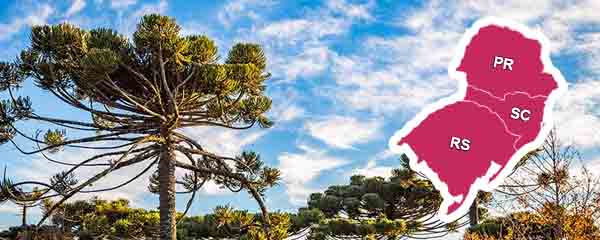
The South Region is one of the five regions of Brazil. It includes the states of Paraná, Rio Grande do Sul, and Santa Catarina. It is heavily influenced by European cultures, as this region got thousands of Italian and German immigrants in the 19th century. This European influence is widely explored in many aspects, such as cuisine and architecture.
The region is also highly urbanized and famous for its urban planning.
Its economy relies on agriculture, livestock, mining, and industry. However, it is worth mentioning that the area is home to great wine and chocolate production in Brazil.
Read more: The Best Brazilian Wines and Great Wineries to Visit in Brazil.
Because of its climate and geography, it is the only region in Brazil where it snows in the mountain ranges. Tourism increases during wintertime when people visit cities like Gramado e Canela for their winter festival and low temperatures.
The South Region is also home to the largest amusement park in Latin America: Beto Carrero World.
Watch teacher Josie’s videos on Paraná, Santa Catarina, and Rio Grande do Sul.
States in the South region
| States | City Capitals |
|---|---|
| Paraná | Curitiba |
| Rio Grande do Sul | Porto Alegre |
| Santa Catarina | Florianópolis |
South Data
| Area | 576,774 km² |
| Population | 29,754,036 |
| Largest city | Curitiba |
| Climate | Subtropical |
| Biome | Pampa; Araucaria moist forests; Atlantic Forest; Cerrado |
| Main economy | Livestock, agriculture, extractivism |
| Traditional food | Arroz Carreteiro, Churrasco Gaúcho, Barreado, Pinhão Cozido |